

What is VLBI?
Understand the principles of VLBI and why radio telescopes are needed for establishing a global coordinate system.
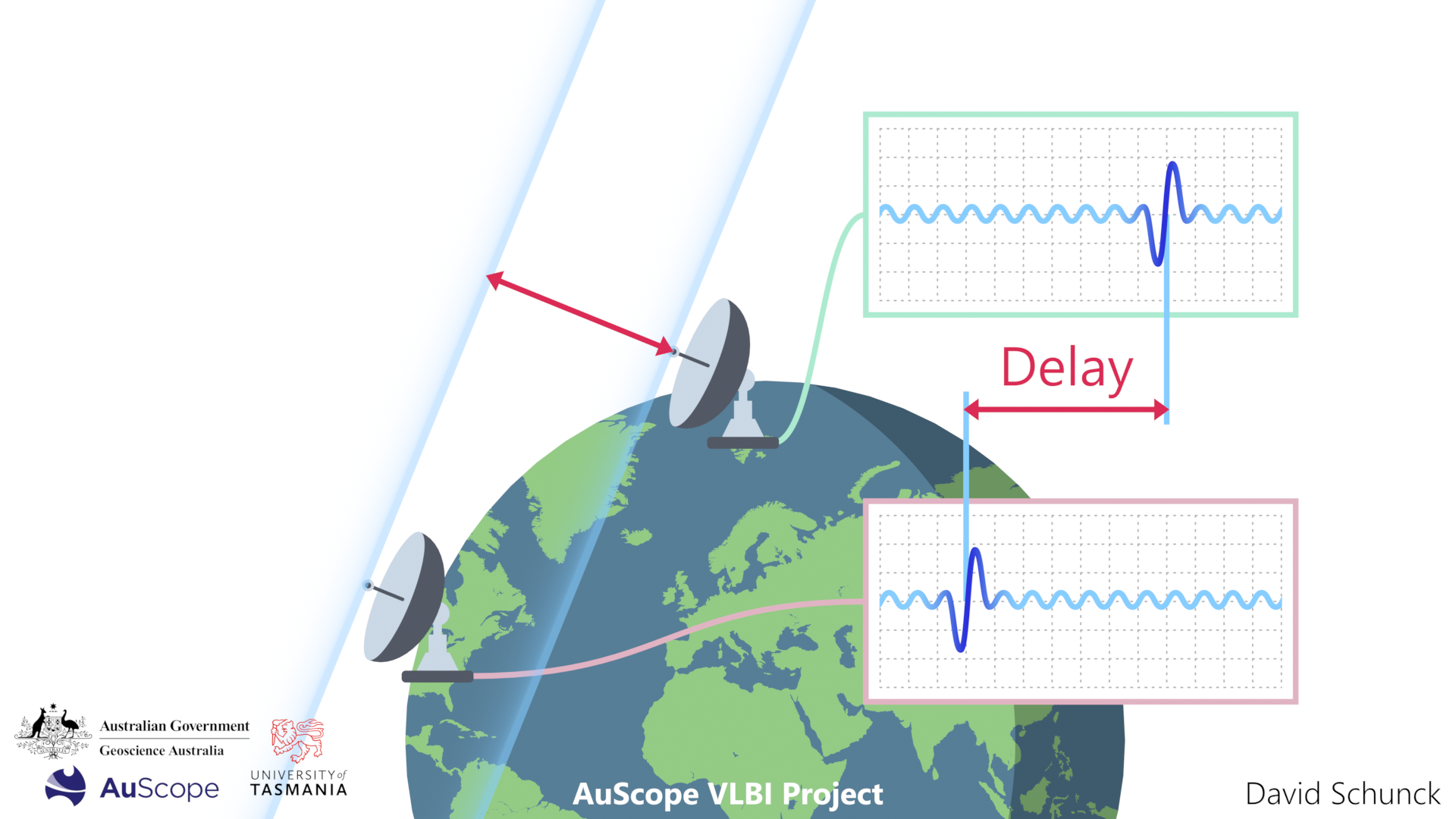
Very Long Baseline Interferometry (VLBI) is a measurement technique based on radio astronomy. Pairs of radio telescopes all across the globe form baselines. The telescopes point at the same extragalactic radio source and record the emitted signals. In a process called correlation, the recordings are aligned. The so-called delay, the main observable in VLBI, represents the difference in the signal arrival times between the pair of radio telescopes. This technique allows us to measure distances between the radio telescopes over thousands of kilometres with a precision of just a few millimetres. Global oberving sessions are coordinated through the International VLBI Service for Geodesy & Astrometry (IVS).

Measuring the relative positions of radio telescopes on the Earth’s surface with millimetre precision allows the definition of a reference coordinate system, called International Terrestrial Reference Frame (ITRF). The axes of this frame move with the Earth’s rotation.
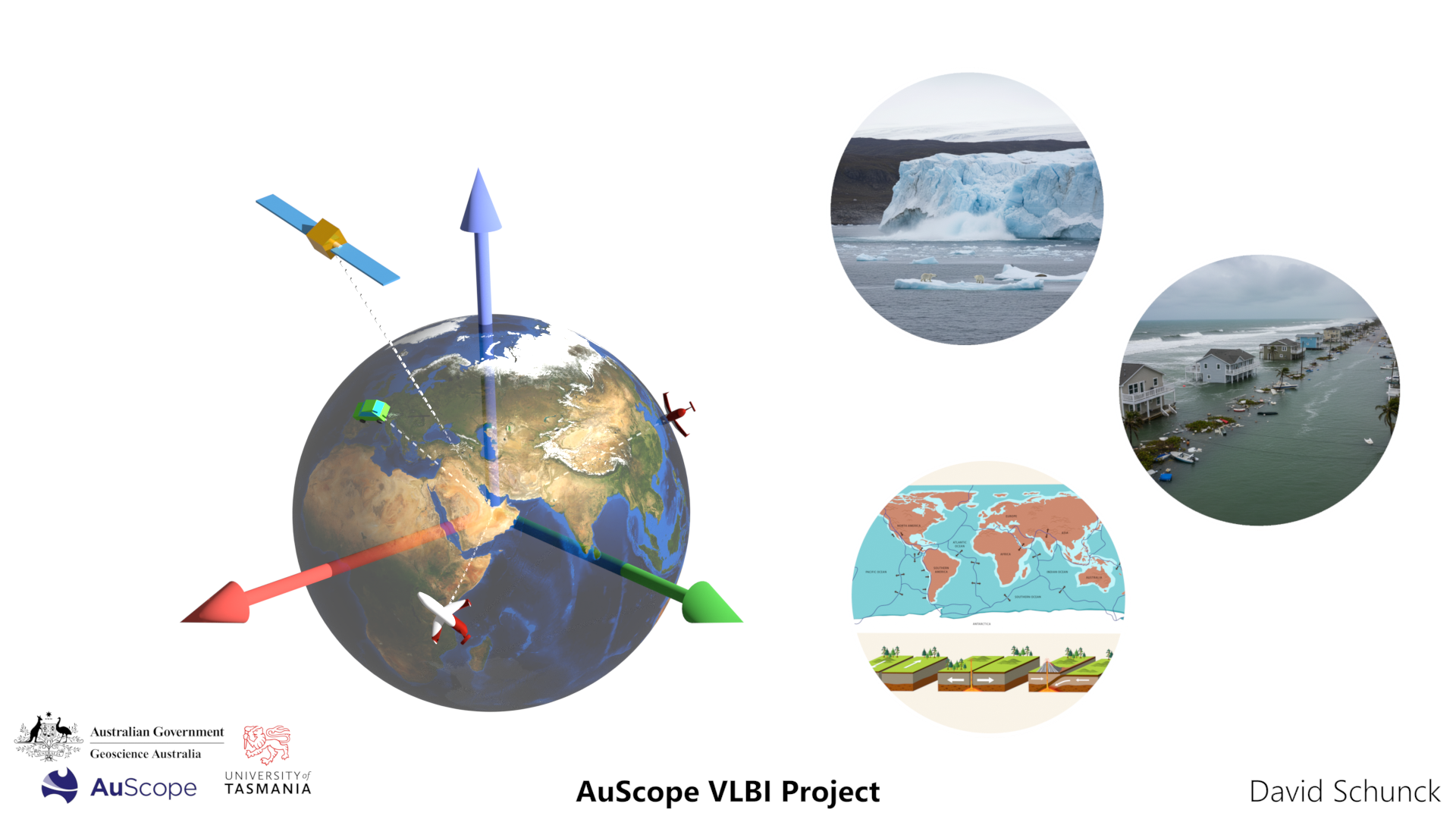
The ITRF is essential for describing the positions of its users, such as people, cars, planes, or satellites. Furthermore, it is the foundation for the determination of global phenomena, such as ice melt, sea-level rise, or plate tectonics, with high accuracy.
This experimental AuScope science communication project was conducted in collaboration with Geoscience Australia and the University of Tasmania (UTAS).
It has been designed, created and produced by Dr David Schunck and Dr Lucia McCallum from the geodetic VLBI research group at the University of Tasmania.
All graphics and animations on this website may be used freely for educational and non-commercial purposes with appropriate attribution.